
Physics Lab

Physics Lab

Overview

The Physics laboratory of our Delhi World Public School, Hooghly serves as hands-on-environment where theoretical concepts meet empirical discovery. Through our physics laboratory, students can explore the fundamental laws governing matter, energy, motion and forces.

Objectives

We encourage critical thinking in our school students by investing unexpected experimental results and troubleshooting apparatus setup. We verify physical laws such as Newton’s laws of motion, Ohm’s law and smell’s law – through direct observation and measurement. We cultivate proficiency in using precision measurement tools and setting up optical systems. We teach quantitative techniques including error analysis, uncertainty, calculation and statistical modelling to our students.
Delhi World Public School Hooghly Campus

Facilities and equipment

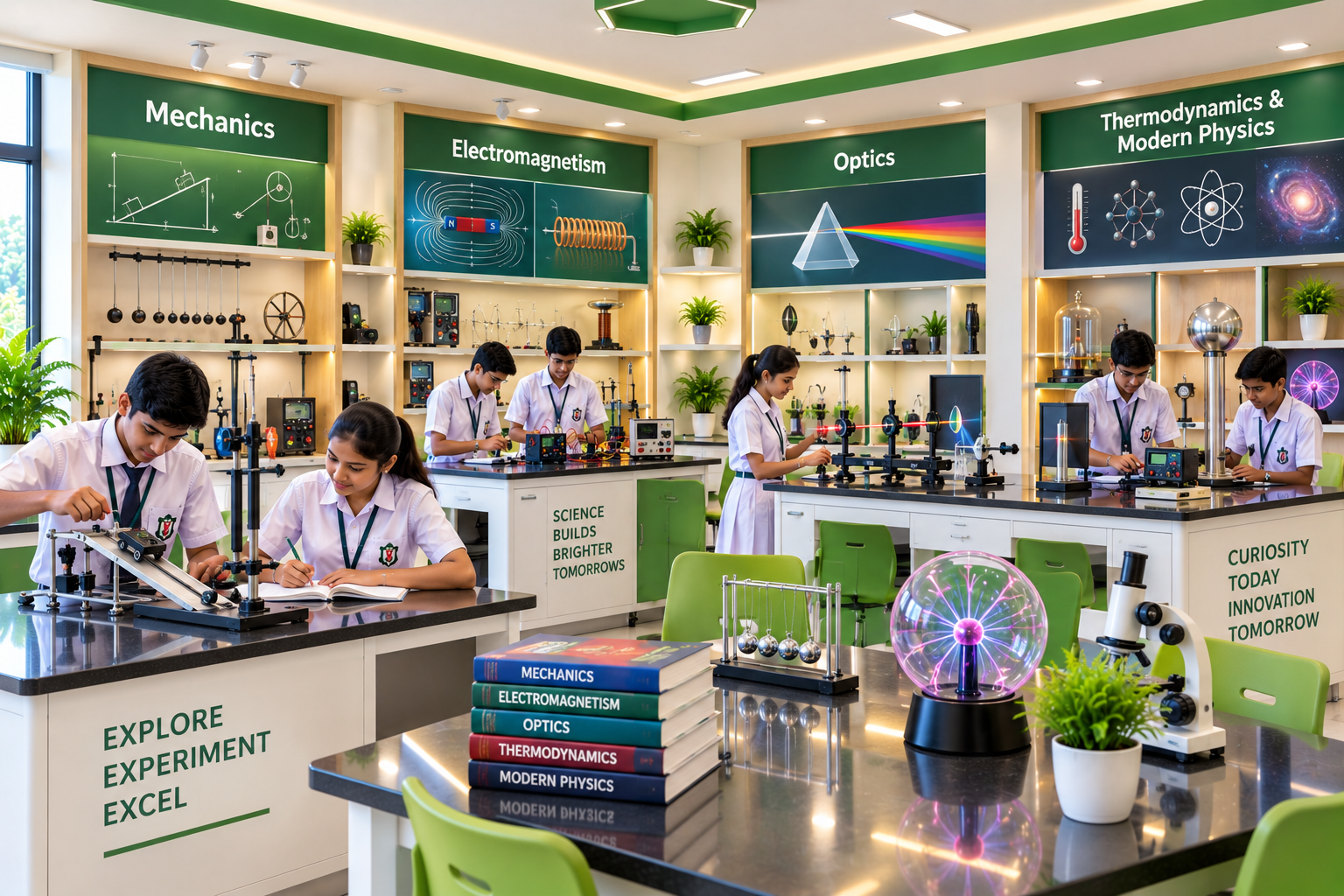
A well-equipped physics laboratory is structured around specialized workstations dedicated to mechanics, electromagnetism, optics, and modern physics:
  • Mechanics – Air tracks, motion sensors, photogates, force sensors, spring constants apparatus, and simple/compound pendulums.
  • Electromagnetism - Digital mustimeters, oscilloscopes, DC/AC power supplies, function generators, galvanometers, and magnetic field mapping kits.
  • Optics - Optical benches, helium-neon or diode lasers, diffraction gratings, convex/concave lenses, prisms, and polarizers.
  • Thermodynamics & Modern Physics - Calorimeters, thermal conductivity kits, spectrometer units, and Planck’s constant experiment setups.
Delhi World Public School Hooghly Campus

Lab activities

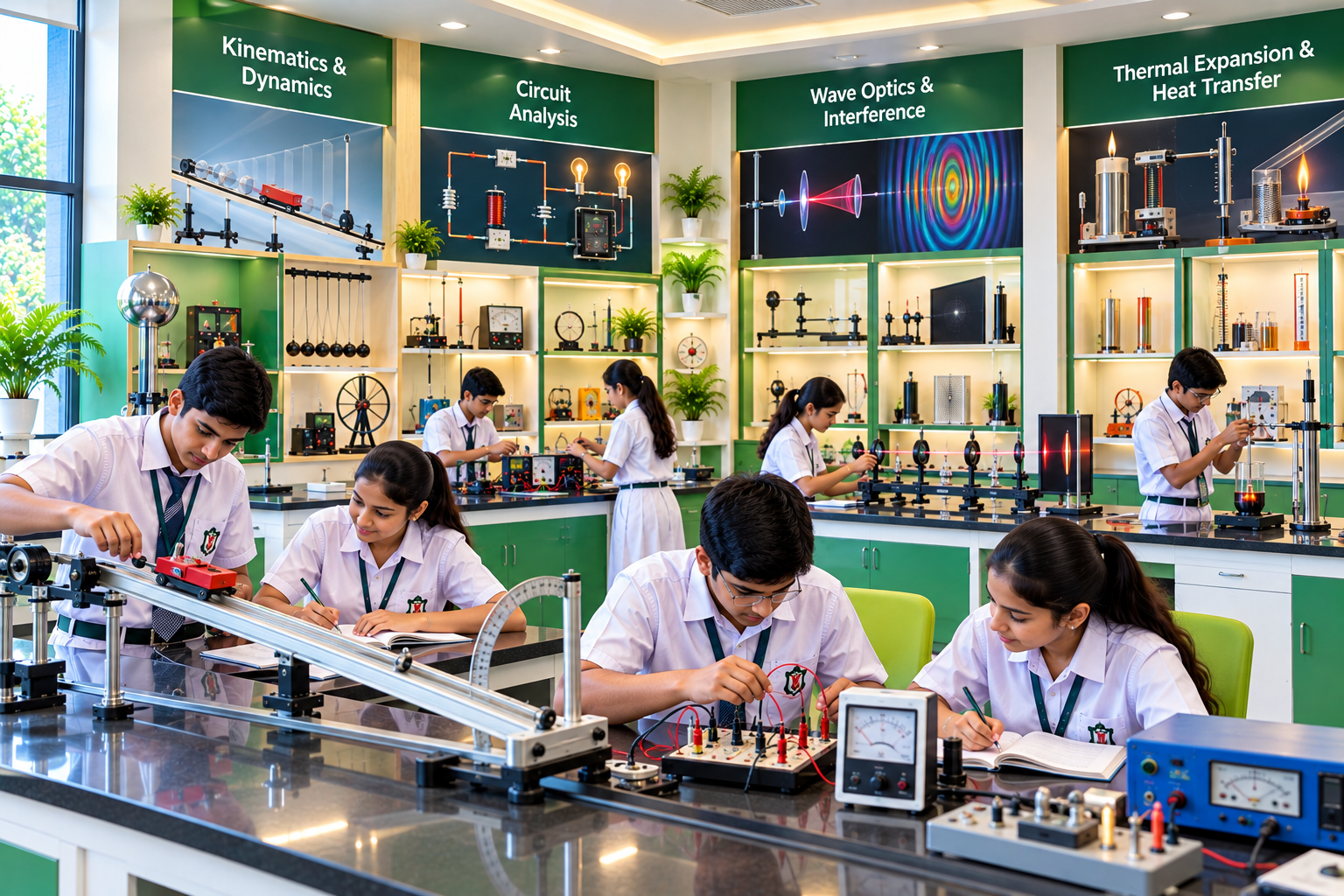
Students engage in different kinds of lab activities tailored to solidify physics domain concepts:

  • Kinematics & Dynamics – Measuring free-fall acceleration (g), analyzing projectile motion, and testing conservation of momentum during elastic and inelastic collisions.
  • Circuit Analysis - Building series and parallel circuits, verifying Kirchhoff’s circuit laws, and analyzing RC/RLC transient responses using oscilloscopes.
  • Wave Optics & Interference - Investigating wave behavior through Young’s double-slit experiment, measuring light wavelengths, and studying refraction properties.
  • Thermal Expansion & Heat Transfer - Determining specific heat capacities of metals and verifying the ideal gas law under varying temperatures and pressures.

Safety protocols

Safety is paramount in maintaining a secure laboratory environment. All users must adhere strictly to the following guidelines:

  • Personal Protective Equipment (PPE) – Wear safety goggles when working with lasers, high-tension springs, or heated apparatus.
  • Electrical Safety - Inspect power cords for fraying before use, keep liquids away from electronic instruments, and ensure power supplies are turned off when rewiring circuits.
  • Laser Handling - Never look directly into a laser beam or direct it toward others; use diffuse reflections where necessary.